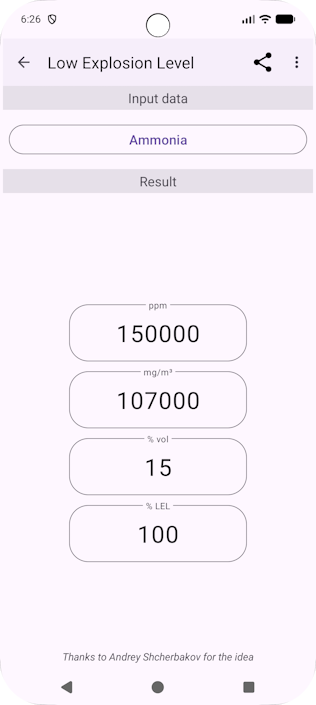
LEL is the lower concentration limit of a gas's flame distribution, above which it can ignite or explode. This limit varies for different gases and is established in specific standards, such as GOST, ISO, and others. It is important to monitor the concentration of flammable and explosive gases in potentially hazardous industrial and civil premises. For this purpose, concentration sensors for specific gases are installed, which trigger alarms, stop the gas flow, and activate protective mechanisms.
GOST R 51330.19-99 (IEC60079) Part 20 provides a table Flammability Data, which defines values and limits for flammable and explosive gases:
- Gas or vapor name
- Chemical formula
- Vapor density in Air (relative units)
- Flash point, °C
- Flame spread limit
- Lower limit: volume fraction, %
- Upper limit: volume fraction, %
- Lower limit: mass concentration, mg/L
- Upper limit: mass concentration, mg/L
- Self-ignition temperature, °C
- Explosion hazard groups
The explosiveness and flammability of gases depends on many conditions, particularly temperature and pressure. Calculating them with sufficient accuracy is virtually impossible. Laboratory testing is conducted.
The Lower Flame Limit (LEL) concentration calculator built into the Instrumentation and Automation app uses data from the aforementioned GOST R 51330.19-99 standard (LEL volume fraction (%) and LEL mass concentration (mg/L) - converted to mg/m3) and linearly converts them into values:
- ppm - parts per million
- mg/m3 - mass concentration
- Volume fraction, %
- % LEL
Finally, a table of gases used in the Instrumentation and Automation app (truncated) and the values of mass concentration, mg/m3, and volume fraction, % LEL, from the original GOST standard are provided.